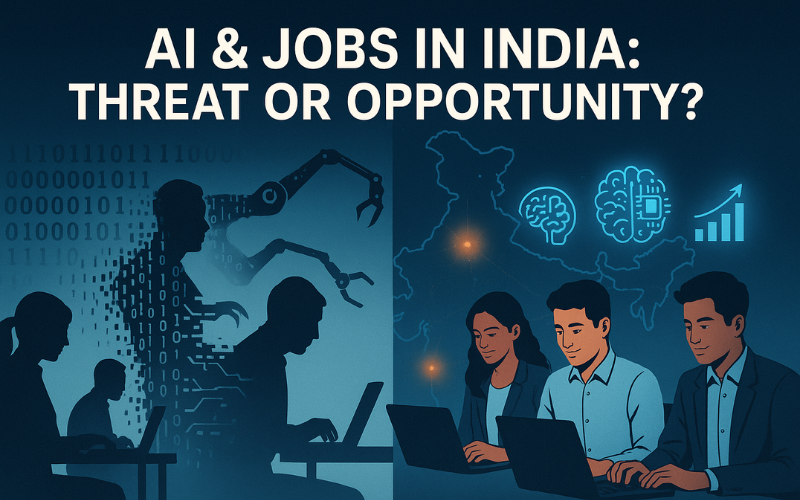
How AI Is Changing Jobs in India: Threat, Opportunity, or Both?
How AI is reshaping jobs, risks, and opportunities in India.
Introduction
Artificial Intelligence (AI) is no longer a future technology in India. It is already inside call centres, banks, hospitals, factories, and even farms.
For Indian workers, this brings a mixed picture: some jobs will disappear, many jobs will change, and new kinds of work will be created.
In this blog, we look at how AI is affecting the Indian job market right now, which roles are at risk, where new opportunities are opening up, and what students and professionals can do to stay relevant.
1. Big Picture: How Fast Is AI Changing Jobs in India?
Before talking about job loss, it is important to understand the overall shift in the Indian labour market.
-
A Deloitte–NASSCOM report estimates that demand for AI talent in India will roughly double from about 600,000–650,000 roles in 2022 to over 1.25 million by 2027, while the AI market itself is expected to grow 25–35% annually.
-
According to IndiaAI, based on the Stanford AI Index 2024, India leads the world in AI skill penetration, and its AI market is projected to grow strongly with significant potential for job creation in data science and AI-driven applications.
-
The World Economic Forum’s Future of Jobs work shows that globally, technology (including AI) is expected to create millions of jobs while also displacing millions of existing roles over the next few years, leading to a net positive impact but serious disruption during the transition.
So, AI is not only destroying jobs; it is also creating high-value work. But the type of work needed is very different from many of today’s routine roles.
2. Jobs at Risk in India: Where Is the Real Danger?
Several recent reports highlight the scale of risk for India as AI and automation spread across sectors.
-
Analysts estimate that around 69% of jobs in India are at risk of automation over the next two decades. This does not mean all of them will vanish, but that a large share of tasks in these jobs can be automated.
-
Bank research cited in Indian business media suggests that 20–25 million jobs in India could be displaced by AI by 2030, especially in IT services, customer support, retail, and finance.
-
International Labour Organization estimates indicate that up to 70% of existing jobs in India could be at high risk from automation and AI when you look at the underlying tasks.
2.1 Roles Most Exposed
Global and Indian studies point to similar categories of jobs that are most exposed to AI-driven automation.
-
Clerical and back-office roles: data entry, basic accounting, routine HR processes, documentation, and simple reporting, where many tasks can be automated by AI systems.
-
Customer support and BPO: chatbots and voice bots can handle large volumes of standard queries, affecting call centre work and basic support roles.
-
Routine IT work: simple testing, basic coding, and maintenance tasks are increasingly handled by AI-assisted development tools.
-
Retail and logistics: self-checkout, automated inventory systems, and route-optimizing algorithms reduce the need for some frontline and middle roles.
For India, which has millions of people working in IT services, BPO, retail, and logistics, this is a serious concern.
3. New Jobs and Opportunities Created by AI
The same forces that threaten some jobs are also creating new ones, especially in technology and data-driven roles.
3.1 High-Demand Roles
Global reports highlight strong growth in roles such as AI and machine-learning specialists, data analysts, big data experts, and information security analysts.
In India specifically, studies show that AI talent demand is expected to more than double by 2027, reflecting rapid adoption of AI across sectors and a growing AI market.
New job families include:
- AI and machine learning engineers, and data scientists
- Prompt engineers and AI application developers
- Cloud engineers, MLOps engineers, and cybersecurity specialists
- AI trainers, annotation specialists, and domain experts who help tune models
- Product managers and consultants focused on AI solutions
3.2 Human + AI Hybrid Jobs
There is also a rise in human plus AI jobs, where AI tools support a human professional instead of replacing them.
- Doctors and radiologists using AI for faster diagnosis
- Teachers using AI tools to personalize learning for students
- Farmers using AI-based advisory apps for crop decisions
- Bankers, marketers, and sales teams using AI to analyze customer data and personalize offers
These jobs reward people who learn to work with AI, not compete against it.
4. India’s Skills Gap: Why Workers Feel Unsafe
The big problem is not just AI itself, but the gap between the skills employers need and the skills many workers actually have.
-
India Skills Report 2023 finds that only about 47% of Indian youth are considered employable, showing a large mismatch between education and industry needs.
-
Upskilling surveys show that more than 80% of professionals planned to upskill in 2023, with strong interest in data science, AI, and cloud.
-
Reskilling reports indicate that around 72% of Indian IT companies now prioritise data science and AI skills for their workforce.
-
World Economic Forum analysis suggests that around 63 out of every 100 Indian workers will need training by 2030, and about 12 out of 100 may not get the training they need, which could be roughly 70 million people.
This explains why there is both huge AI opportunity and huge anxiety at the same time.
5. How Indian Employers Are Responding
Most serious employers are not waiting for the government alone to solve the skills problem. Many are acting on their own.
-
Studies show that more than four out of five employers in India plan strategies to help workers adapt to AI, such as reskilling, moving staff from declining roles into AI-related roles, or hiring specialised AI talent.
-
Nearly two-thirds of companies operating in India plan to tap more diverse talent pools to fill new tech roles, a proportion that is higher than the global average.
-
HR research on Indian organizations shows a rise in structured reskilling and upskilling programs, especially in large IT and banking firms, though small and medium companies often lag because of cost and capacity issues.
If you already work in a forward-looking company, you might see internal training, AI tools rolled out with support, and new AI-related roles opening up. In more traditional or smaller firms, the adjustment may be slower and more painful.
6. Who Feels the Impact Most: Entry-Level vs Experienced Workers
Global labour-market analysis suggests that younger workers in highly exposed jobs have faced more disruption than older professionals in similar roles.
This pattern also fits what many Indian graduates feel.
-
Entry-level, routine work such as basic coding, BPO tasks, and simple analytics is easiest for AI to automate.
-
Experienced professionals often move into roles that oversee AI systems, design strategy, or work directly with clients and complex problems, which are harder to replace.
For India, this means fresh graduates with only textbook skills and no AI exposure may struggle to get a first job, while mid-career workers who actively upskill in AI and analytics can actually become more valuable than before.
7. Practical Advice for Indian Students and Professionals
Here are some clear, realistic steps if you are worried about AI and your job in India.
7.1 Move from “Task Doer” to “Problem Solver”
AI is very good at repeating tasks but weaker at understanding messy human situations.
- Focus on roles that require judgement, communication, and context, not just clicking buttons.
- For example, instead of being only a report maker, become someone who explains what the data means to business leaders.
7.2 Learn at Least One AI-Related Skill
You do not have to be a deep-learning researcher. Even basic AI familiarity helps.
- Data analysis with Python or SQL using tools like Power BI or Tableau.
- Prompt engineering and using AI tools to speed up your work.
- Cloud basics such as AWS, Azure, or GCP and using APIs.
- Domain-specific AI tools in HR tech, fintech analytics, edtech platforms, and more.
Given that AI talent demand in India is expected to more than double by 2027, these skills have strong market value.
7.3 Combine Domain Knowledge with AI
India needs people who understand both AI and the local context.
- Healthcare plus AI for diagnostics and decision support.
- Finance plus AI for credit scoring and fraud detection.
- Agriculture plus AI for crop advisory and climate risk management.
- Manufacturing plus AI for predictive maintenance and quality control.
If you already know a domain well, adding AI skills can transform you from a generic worker into a specialist.
7.4 Take Reskilling Offers Seriously
Many Indian companies are launching training programs, online learning access, or internal academies.
- If your employer offers such programs, treat them as a career investment, not just extra work.
- If not, look at low-cost online options for data, AI, and digital skills.
7.5 Build “Safe” Human Skills
Reports emphasize rising demand for human strengths that remain valuable even in an AI-heavy world.
- Analytical and creative thinking.
- Leadership, communication, and team skills.
- Resilience, flexibility, and adaptability.
AI may write a draft email, but it will not run a difficult client meeting or manage a diverse team for you.
8. What This Means for India as a Whole
India is in a special position when it comes to AI and jobs.
-
It has one of the largest STEM talent pools in the world and already leads in AI skill penetration.
-
At the same time, a large share of its workforce is in jobs that are vulnerable to automation, and many young people are still not job-ready according to employers.
The impact of AI on the Indian job market will not be a simple story of all jobs lost or all jobs upgraded. It will depend on how fast companies invest in reskilling, how quickly individuals learn AI and digital skills, and how well government programs, universities, and industry work together on curriculum and training.
If India manages this transition well, AI can actually help it create millions of higher-quality jobs and move up the value chain. If not, the country risks job polarization, where a small group of highly skilled workers do very well while many others struggle.
Conclusion
AI is already reshaping the Indian job market. Routine, repetitive roles—especially in BPO, clerical work, and basic IT services—face real risk from automation. At the same time, demand for AI, data, and digital skills is exploding, and India is positioned to be a global leader in AI talent.
For workers, the key message is simple: AI will not take your job if you learn to work with it. The real risk is staying still while the world moves on. If you invest in new skills, combine AI with your domain knowledge, and build strong human abilities like problem-solving and communication, the AI wave in India can become a career opportunity instead of a threat.
Key Takeaways
-
AI in India is a double-edged sword: it threatens routine jobs but is also creating high-value tech and hybrid roles.
-
Large-scale disruption is likely, with different reports suggesting tens of millions of Indian jobs could be affected or reshaped by 2030.
-
The core issue is a skills gap: only about half of Indian youth are considered employable, even as companies urgently seek AI and digital skills.
-
Reskilling is becoming the norm as Indian employers and professionals focus more on upskilling in data, AI, and cloud, not just traditional IT.
-
Individuals who adapt, mix AI skills with domain expertise, and build strong human abilities are likely to see better job security and growth.
References
- World Economic Forum – The future of jobs in India: employers seek to boost tech talent to drive AI and digital technology growth (April 2025)
- IndiaAI – India leads global AI talent and skill penetration (December 2024)
- Acumen Research & Consulting – How the future of work automation is shaping India’s job market (October 2025)
- Fortune India – Over 2 crore jobs at risk: Can India surpass AI’s disruption? (May 2025)
- Deloitte & NASSCOM – Bridging the AI talent gap to boost India’s tech and economic impact (report summary)
- Advances in Consumer Research – Reskilling and upskilling in Indian organizations: HR strategies for the future of work (India Skills Report 2023 discussion)
- Great Learning – Upskilling trends in India 2023–2024
- Boston Institute of Analytics – The Great Reskilling Report: 72% of Indian IT companies prioritizing data science and AI skills
- World Economic Forum – The jobs most likely to be lost and created because of AI (May 2023)
- IndiaAI – WEF report: India to drive global AI talent demand, workforce shift (January 2025)