Introduction
Shipping an AI feature is not the same as shipping a normal software feature. A button that fails can annoy users. An AI feature that fails can confuse them, expose sensitive data, create unfair outcomes, or quietly damage trust.
That is why evaluation before release matters. A good pre-release process helps teams check not only whether the feature works, but whether it is safe, reliable, understandable, and worth launching at all.
Date Context
This article is based on publicly available information as of April 2026.
What does it mean to evaluate an AI feature?
Evaluating an AI feature means testing it from more than one angle before it reaches real users. That includes classic product questions such as usefulness and quality, but also AI-specific questions such as hallucinations, prompt sensitivity, safety failures, bias, privacy exposure, and resistance to misuse. NIST’s AI Risk Management Framework and its Generative AI Profile both support this broader view of evaluation, where teams assess trustworthiness, risk, and context of use rather than relying on one accuracy score alone.
In practical terms, a release decision should answer a simple question: Is this feature good enough, safe enough, and understandable enough for its intended use? If the answer is unclear, the feature is not ready.
Why this matters more for AI than for normal software
AI systems can behave unpredictably across different prompts, user groups, and edge cases. Official guidance from Google emphasizes policy definition, transparency, and protection against malicious use as part of responsible deployment, not as optional work after launch.
There is also growing external pressure. The EU AI Act creates a risk-based legal framework, and its obligations roll out in phases depending on the type of AI system and the use case. That means some teams now need to think about evaluation not just as product quality control, but also as compliance preparation.
Start with the intended use, not the model
Before measuring anything, define these four basics:
1. What problem is the feature solving?
Be precise. “AI assistant for support agents” is too broad. “Drafts reply suggestions for billing tickets in English” is better.
2. What should success look like?
Success might mean faster resolution time, higher acceptance rate of suggestions, fewer manual steps, or improved user satisfaction.
3. What failures are unacceptable?
Examples:
- giving harmful medical or legal advice
- exposing personal data
- inventing account details
- producing toxic or discriminatory output
- sounding overly confident when uncertain
4. Who will be affected if it fails?
The answer changes the evaluation bar. A fun writing helper and an AI feature used in lending, education, hiring, or healthcare should not be judged by the same release standard. This risk-based approach is consistent with NIST guidance and the structure of the EU AI Act.
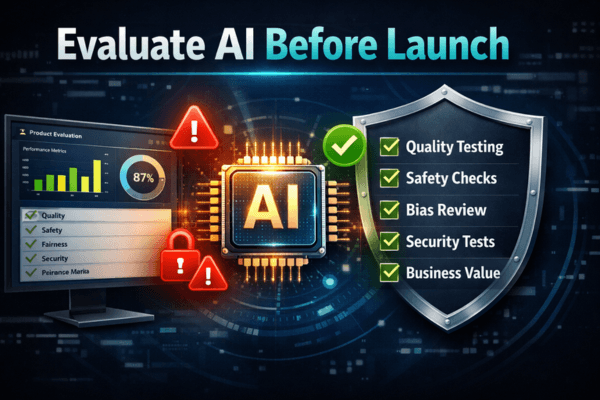
The five checks every team should run before release
1. Quality evaluation: Does it actually do the job well?
This is the most obvious layer, but many teams still evaluate too narrowly. Do not stop at “it looked good in demo tests.”
Check:
- correctness
- completeness
- relevance
- groundedness to source material, if retrieval is involved
- consistency across prompt variations
- performance on realistic user tasks
Google’s evaluation guidance for generative AI emphasizes building an evaluation dataset with prompts, responses, and, where possible, reference answers or baseline responses so teams can compare outputs systematically instead of relying only on intuition.
A useful rule is to test on:
- happy-path examples
- messy real-world examples
- rare edge cases
- adversarial or tricky inputs
- samples from different user segments
2. Safety evaluation: What could go wrong?
A feature can be helpful in normal use and still be risky in the real world. Safety testing should include misuse scenarios, not just intended usage.
Look for:
- harmful instructions
- policy violations
- unsafe advice
- jailbreak susceptibility
- prompt injection risks
- data leakage
- generated content that could mislead users
NIST’s generative AI guidance specifically highlights red teaming as a useful practice, with results feeding back into governance, process updates, and risk management rather than being treated as a one-time stunt.
3. Fairness and user impact: Who performs worse?
Not every AI feature has the same fairness concerns, but many do. If users from one group systematically get worse outputs, that is a product problem even if the average score looks good.
Test for:
- uneven performance across language, accent, geography, or demographic proxies
- higher refusal or failure rates for some user groups
- different quality levels based on name, tone, or writing style
- downstream impact on access, opportunity, or treatment
This matters especially for higher-risk use cases, where legal or reputational consequences can be serious. Microsoft’s responsible AI materials and NIST’s framework both reinforce the need to document intended use, limitations, and release criteria instead of relying on generic claims of fairness.
4. Security and robustness: Can it be manipulated?
AI features need adversarial testing. Attackers and even normal users may phrase things in ways your team did not expect.
Test:
- prompt injection
- indirect prompt injection from retrieved content
- jailbreak attempts
- output manipulation
- training or retrieval data poisoning risks
- model behavior under malformed or hostile inputs
NIST’s adversarial machine learning taxonomy and newer cybersecurity work around AI both show that robust evaluation should consider attacker goals, capabilities, and lifecycle stages of attack.
5. Business evaluation: Is this feature worth releasing?
A feature can be technically impressive and still not deserve launch.
Measure:
- user adoption intent
- completion rate
- time saved
- effect on support load or conversion
- cost per successful task
- human review burden
- rollback or override rate
If an AI feature saves 10 seconds but creates frequent corrections, escalations, or trust issues, it may not be a good product decision. Evaluation should include both technical quality and operational value.
Build a release scorecard, not a single metric
One of the biggest mistakes teams make is trying to reduce launch readiness to one number. AI systems need a scorecard.
A simple scorecard may include:
- task quality
- hallucination rate
- safety violation rate
- sensitive-data leakage rate
- subgroup performance spread
- attack success rate
- latency
- cost per task
- user trust or satisfaction
- human escalation rate
Microsoft’s Responsible AI Standard explicitly calls for defined release criteria tied to the intended problem, metrics, and error analysis. That is a strong model for product teams: decide the pass/fail thresholds before launch pressure begins.
Use three stages of testing before launch
Offline evaluation
Use curated datasets, benchmark prompts, and known edge cases. This stage is best for repeatability.
Simulated or red-team evaluation
Try to break the system deliberately. Include misuse, abuse, confusing wording, and hidden-instruction cases.
Limited real-world rollout
Release to a small group, internal users, or a guarded beta. Watch actual behavior before full launch.
This staged approach matches the broader direction of current official guidance: evaluation should be ongoing and adaptive, not a one-time checkbox. Google and NIST both frame responsible AI work as iterative review and refinement.
Current context: why teams are tightening evaluation now
The broader environment is changing. Governments and standards bodies are pushing for more rigorous risk management, transparency, and testing. The OECD’s work on AI incidents reflects a clear policy trend: organizations need better evidence about how AI fails in practice, not just how it performs in lab settings.
At the same time, frontier-model evaluators such as the UK AI Security Institute have published evidence that advanced model capabilities can change quickly, which makes static assumptions risky. That does not mean every product needs frontier-level testing, but it does mean evaluation standards should be reviewed regularly rather than frozen after version one.
Common mistakes before release
Treating demo success as proof
A polished internal demo is not evidence of production readiness.
Testing only ideal prompts
Real users are vague, rushed, inconsistent, and sometimes adversarial.
Ignoring uncertainty
If the model is unsure, the product should show that uncertainty or escalate gracefully.
Measuring output quality but not user harm
A fluent answer can still be misleading.
Releasing without clear fallback behavior
Teams should define what happens when the AI cannot answer safely or confidently.
A practical pre-release checklist
Before launch, a team should be able to say yes to most of these:
- We defined the intended use clearly.
- We documented unacceptable failure modes.
- We tested on real and adversarial examples.
- We measured safety, not just quality.
- We checked subgroup performance where relevant.
- We reviewed privacy and security risks.
- We set written release thresholds.
- We have a human fallback or escalation path.
- We know how we will monitor the feature after launch.
- We are prepared to pause or roll back if needed.
When not to release yet
Sometimes the best decision is delay.
Hold the release if:
- outputs are useful only with heavy human correction
- failure modes are hard to detect
- safety incidents remain frequent
- evaluation data does not reflect real user behavior
- the team cannot explain limitations honestly to users
- compliance questions are still unresolved for a regulated use case
That is not failure. It is product discipline.
Conclusion
Evaluating an AI feature before release is really about earning the right to launch it. The goal is not perfection. The goal is to understand how the system behaves, where it breaks, who it may harm, and whether it creates enough value to justify real-world use.
Teams that do this well usually treat evaluation as a release gate, not a slide in a presentation. That approach leads to better launches, fewer surprises, and stronger user trust over time.
Key Takeaways
- AI features should be evaluated for quality, safety, fairness, robustness, and business value, not just accuracy.
- A release scorecard is more useful than a single pass/fail metric.
- Red teaming and adversarial testing matter before launch, especially for generative AI.
- Higher-risk or regulated use cases need a stricter evaluation bar.
- A limited rollout with monitoring is often safer than a full public release.
Verification Note
This blog follows the verified, fact-first writing brief you provided. It is based on publicly available and verifiable information from reputable sources. Unsupported claims, invented statistics, and unverified quotes have been avoided. Where the article includes interpretation, it has been presented as practical analysis rather than as a verified fact.
References
- NIST — AI Risk Management Framework — official framework page.
- NIST — Artificial Intelligence Risk Management Framework: Generative AI Profile — 2024.
- Google AI for Developers — Design a responsible approach — July 17, 2024.
- Google Cloud Vertex AI — Prepare your evaluation dataset and Define your evaluation metrics — current documentation.
- OECD — AI risks and incidents — official overview of the AI Incidents Monitor.
- European Commission — AI Act | Shaping Europe’s digital future — updated February 2, 2025.
- Microsoft — Microsoft Responsible AI Standard, v2 — guidance on intended use, release criteria, and error analysis.
- NIST — Adversarial Machine Learning: A Taxonomy and Terminology — 2025.